
Coverage Into Hard-to-Reach Areas
E-coat is an immersion process driven by electrical current. It provides consistent coverage across exposed surfaces and into tubes, box sections and weld seams that are difficult to reach with spray.
How Electrocoating Works
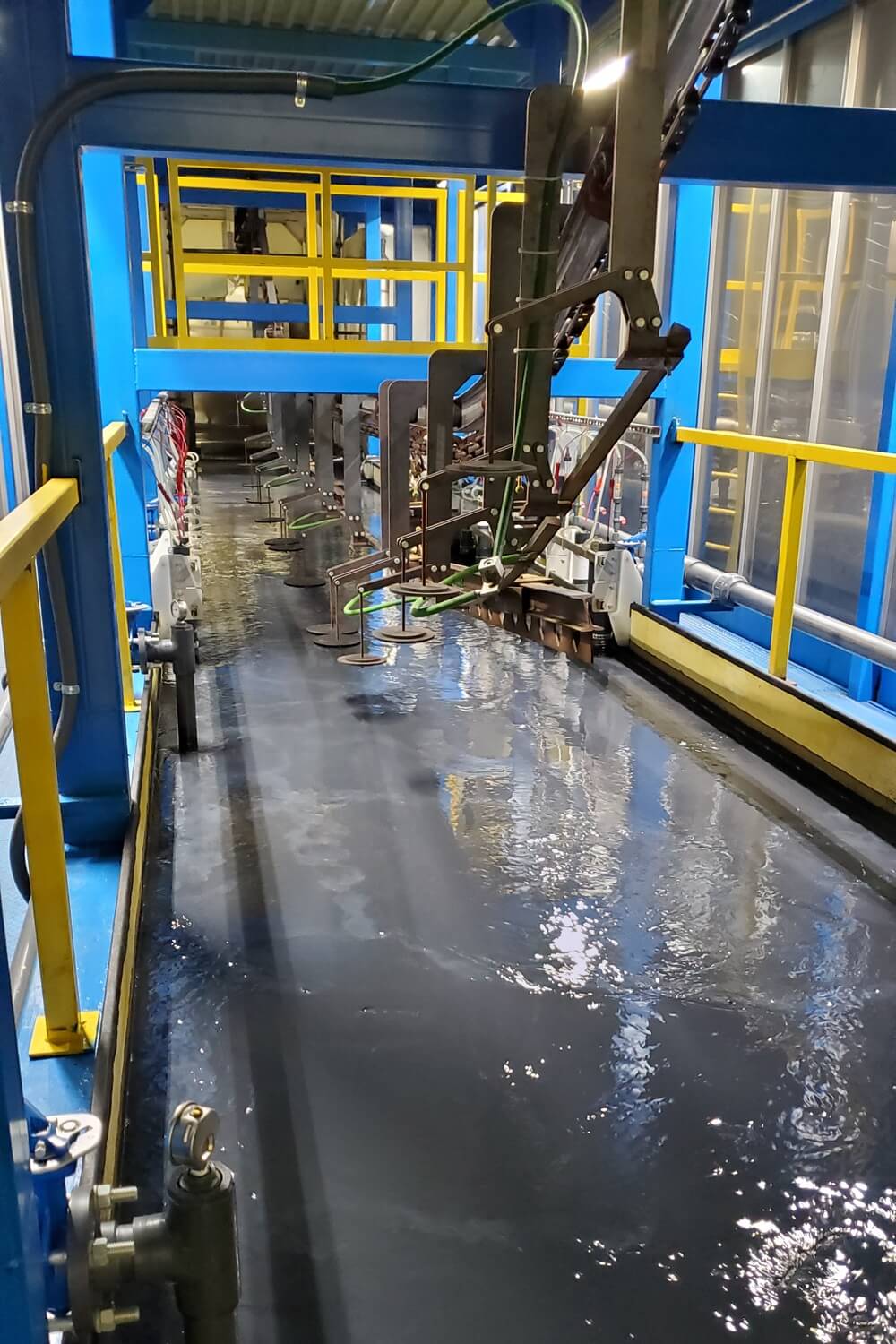
The product is submerged in a water-based bath and charged. Coating particles move toward the metal and deposit until the film reaches its insulating point.
This self-limiting process helps control film thickness across different geometries and production runs. It provides consistent coverage without the runs and sags associated with over-applied wet paint.
Because current follows the conductive surface rather than a spray line of sight, e-coat can reach interior surfaces, overlapping joints and other areas that are difficult to cover with a spray gun.
Our Standard Sequence
-
Multi-Stage Cleaning
Alkaline cleaning and rinsing remove oils, shop soil and weld residue so the surface is ready for coating.
-
Pretreatment
A conversion coating improves adhesion and adds another layer of corrosion resistance beneath the e-coat film.
-
Immersion and Deposition
Products are racked and lowered into the bath. Voltage and dwell time are controlled to achieve the specified film thickness.
-
Rinse
Undeposited material is rinsed away and recovered back into the bath, helping reduce coating waste.
-
Bake
The film is cured to full cross-link, producing a hard, tightly adherent coating ready for shipment or a topcoat.
What E-Coat Does Well
Complete Coverage
E-coat can reach interior surfaces, weld seams, hem flanges and recessed areas that are difficult to cover with spray.
Repeatable Film Build
The self-limiting process helps produce consistent film thickness across production runs and provides clear data for documentation.
Corrosion Performance
With proper pretreatment, e-coat provides corrosion protection for demanding specifications, including welded assemblies.
High Transfer Efficiency
Rinsed material is recovered and returned to the bath, helping reduce coating waste and improve material efficiency.
Primer Base
E-coat is commonly used as a primer under powder or liquid topcoat, combining corrosion protection with the required final appearance.
Built for Volume
E-coat is suited to steady production volume, where controlled processing and repeatable results matter.
When E-Coat Is the Right Answer
- Welded assemblies with interior surfaces to protect
- Tubular, boxed or hollow structures
- Parts with a salt spray or corrosion requirement
- Steady, repeating production volume
- Work that will receive a powder or liquid topcoat
When Another Process May Fit Better
- Very low quantities or one-off prototypes
- Products needing an exact decorative color as the final finish
- Non-conductive substrates, which cannot be electrocoated
- Products too large for the tank, where powder or liquid may be a better route
For non-ferrous or specialty requirements, we can review other immersion and coating options that do not rely on electrical current.
Other Services to Consider
Let's Talk About Your Project
Send us a print, volume and a few details... and you'll get a prompt reply from one of our experts - process recommendation, lead time and price.